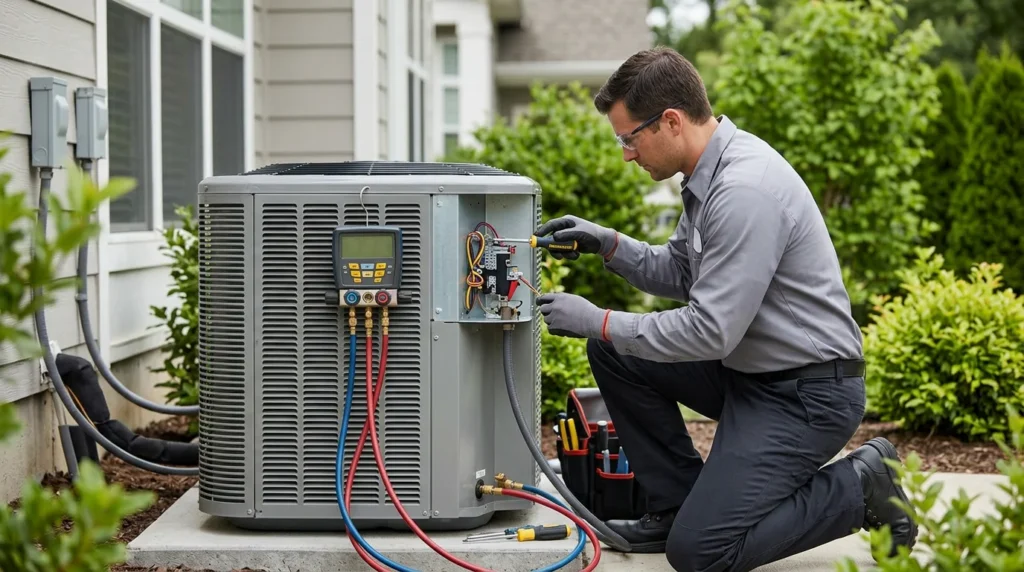
Quick answer: If your AC cools evenly, starts and stops normally, and airflow feels strong, maintenance like a filter change, coil cleaning, or a drain-line flush is often enough. Repair is more likely with warm air, weak airflow, repeated cycling, water around the unit, burning smells, or sudden spikes in humidity or noise. A few safe checks (thermostat, filter, drain, basic temperature split) can help you decide next steps.
Quick Signs It’s a Repair (Not Just a Tune-Up)
Maintenance handles routine buildup and minor adjustments; repairs address failed parts or control problems. If your system is blowing warm air, struggling to start, or can’t keep up even at night, that’s more consistent with a repair need than a simple checkup. The same goes for weak airflow from multiple vents, rattling or grinding noises, or a thermostat that seems “ignored” by the system.
Moisture clues matter in Florida. Water pooling near the indoor unit can come from a clogged condensate drain, a cracked drain pan, or a coil that froze and is thawing. A musty smell can suggest moisture or microbial growth around the air handler, while a sharp electrical or burning odor is a reason to shut the system off and get help. If you’re searching for ac repair wellington because the unit keeps tripping the breaker, short-cycling, or making new loud sounds, that’s typically beyond routine maintenance.
One practical rule: if you’ve already changed the filter and the problem persists within a day, you may be dealing with a component issue (capacitor, contactor, blower motor, refrigerant-related issue, or a control/thermostat fault). Airflow restrictions elsewhere (like a blocked return or closed registers) can still mimic some of these symptoms, so treat this as a clue, not a guarantee.
Maintenance vs Repair vs Stop Now (Quick Decision Table)
Use this as a fast triage tool based on the same symptoms you’re already noticing at home.
Maintenance likely: airflow feels normal but comfort is slightly off; filter is dirty; outdoor unit is surrounded by leaves/grass; mild musty smell that improves after filter change; condensate drain looks slow but not overflowing.
Repair likely: warm air from vents; weak airflow at multiple vents even with a clean filter; repeated short cycling; new rattling/grinding noises; persistent high indoor humidity; thermostat behavior seems inconsistent after fresh batteries and correct settings.
Stop and call now: burning/electrical smell; breaker trips repeatedly; visible ice on the refrigerant line/indoor coil; active water leaking or pooling that could damage floors/ceilings; loud screeching or metal-on-metal sounds.
What You Can Check Safely Before Calling
You can rule out a few common, low-risk issues in 10–15 minutes. Start with the thermostat: confirm it’s set to “Cool,” the temperature is set below room temp, and the fan is on “Auto.” Replace the batteries if it’s battery-powered. Next, check the air filter. Use the correct size (printed on the filter frame) and install it with the airflow arrow pointing toward the blower. As general guidance, a filter that’s too restrictive for your system can reduce airflow; if you recently changed to a higher-MERV filter and problems started, switching back to the previously used type can be a useful test.
Try a homeowner-safe temperature check as a rough indicator (not a diagnosis). After the system has run steadily for about 10–15 minutes, measure the air temperature at a return grille and at a nearby supply vent with a simple thermometer. Many properly operating systems show a supply-to-return difference often around 14–22°F, but real results vary with humidity, airflow, duct losses, and where you measure. A very low split can happen with low capacity or airflow issues; an unusually high split can also happen with restricted airflow, so use this only as a “something’s off” flag.
Go outside and clear leaves or grass from the condenser, keeping open space around it. Inside, check for a condensate drain backup: look at the drain pan (if accessible) and the area around the air handler for dampness, and see whether the drain line’s outlet is dripping while the AC runs. No dripping doesn’t always mean a clog (low humidity days can produce less water), but water in the pan, a tripped float switch, or repeated shutoffs can point to a drainage issue. If you see ice on the refrigerant line or indoor coil, turn cooling off and set the fan to “On” to thaw it; then schedule service, because icing often involves low airflow or a refrigerant/control problem.
Avoid DIY electrical or refrigerant work. Replacing capacitors, opening panels beyond basic access, or adding refrigerant can be unsafe and can worsen the problem.
Common Repairs That Get Misread as “Just Maintenance”
Some failures look like dirty filters. A weak capacitor can make the outdoor unit hum or struggle to start, which can lead to warm air indoors. A failing blower motor or blower capacitor can mimic a clogged filter by reducing airflow. A stuck contactor can cause the outdoor unit to run when it shouldn’t, while a miscalibrated thermostat or a poor thermostat location can contribute to short cycling and uneven comfort.
Refrigerant problems are another common confusion point. Refrigerant doesn’t get “used up” in a sealed system, so low refrigerant often points to a leak, but measurement errors, airflow restrictions, or coil issues can create similar symptoms. Signs that can fit either category include longer run times, poor cooling, ice buildup, and higher indoor humidity. A proper service visit should check airflow and coil condition along with refrigerant charge, rather than assuming one cause from symptoms alone.
If the system is older, repeated small repairs can be a sign to discuss replacement options. A technician can compare the condition of major components (like the compressor, coils, and blower) with the likely repair path over the next season.
Schedule a diagnostic visit if these checks don’t resolve it, especially for electrical smells, breaker trips, icing, or active leaks.