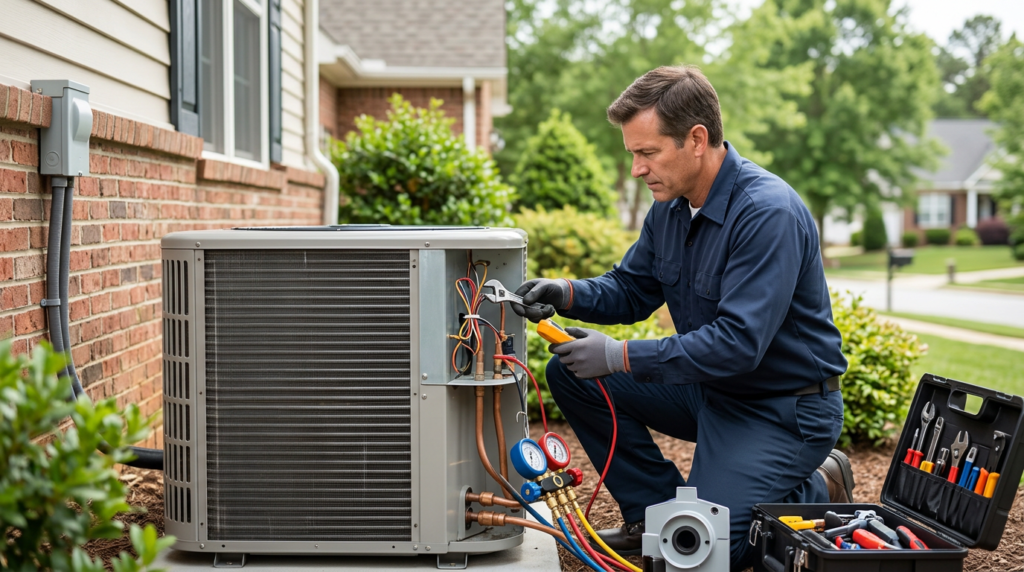
Quick answer: You likely need heat pump repair if your system can’t hold the thermostat setting, runs constantly without warming or cooling, makes new grinding or squealing noises, ices up repeatedly, or trips the breaker. Normal operation includes longer run times in extreme weather, brief whooshing during defrost, and mild airflow that still changes room temperature over time. Persistent performance drops or safety issues warrant a service call.
Quick Signs Something’s Actually Wrong
Heat pumps can feel “different” than furnaces or straight AC. The air coming from the vents often feels lukewarm, especially in heating mode, because the system moves heat rather than creating it. If rooms still reach the set temperature and the unit cycles off occasionally, that’s usually normal.
Call for heat pump repair Eatonton if you notice clear changes: the thermostat never reaches setpoint, the outdoor unit runs but the indoor air stays the same, airflow suddenly weakens, or you hear new metallic rattling, grinding, or a high-pitched squeal. Repeated icing on the outdoor coil (beyond a light frost that clears during defrost) is another red flag, as is water leaking around the air handler that keeps coming back after you change the filter.
Electrical symptoms count, too. A breaker that trips more than once, a burning smell, or buzzing from the disconnect or panel should be treated as a safety issue—shut the system off and get it checked.
What You Can Check Safely Before You Call
A few simple checks can save time and help you describe the problem. Start with the thermostat: confirm it’s set to “Heat” or “Cool” (not “Emergency Heat” unless needed) and that the temperature setting is reasonable. Replace or clean the air filter if it looks loaded with dust; a clogged filter can cause weak airflow, coil icing, and noisy operation.
Next, look at the outdoor unit. Clear leaves, pine straw, or mulch piled against the sides so air can move freely. In winter, make sure the unit isn’t buried by debris and that the fan can spin. If you see a solid block of ice that doesn’t melt after a defrost cycle, turn the system off to prevent damage and call a technician.
Finally, check supply registers and return grilles inside. Closed registers, furniture blocking returns, or a collapsed flex duct in an attic can mimic equipment failure by starving the system for airflow.
Common Heat Pump Problems Technicians See
Many “no heat/no cool” calls trace back to airflow and control issues: dirty filters, blower problems, clogged condensate drains (which can trigger float switches), or failed capacitors that keep motors from starting. Refrigerant issues can also show up as poor heating/cooling, hissing, or icing, but adding refrigerant without fixing the leak just repeats the problem.
In heating mode, a heat pump also relies on a defrost system. If a defrost sensor, control board, or reversing valve is failing, you might see frequent icing, odd temperature swings, or the unit stuck in one mode. Another common complaint is “cold air” that’s actually the auxiliary heat not coming on when it should, or coming on too often because the heat pump isn’t transferring heat efficiently.
If your system is short-cycling (turning on and off every few minutes), that can point to an electrical control issue, overheating due to poor airflow, or an incorrectly sized system. Short-cycling wastes energy and can accelerate wear.
How to Decide Between Repair and Replacement
Repairs make sense when the issue is isolated (like a capacitor, contactor, sensor, or minor airflow correction) and the system has otherwise been reliable. Replacement becomes more attractive when major components fail (compressor or refrigerant coil), when leaks are recurring, or when comfort problems persist even after multiple fixes.
A practical way to think about it is total risk and downtime. If your system is older and you’re facing a high-impact repair, ask for a clear explanation of what failed, what caused it, and what could be next. Also ask what maintenance steps would reduce repeat problems—filter schedule, coil cleaning, drain care, and keeping the outdoor unit clear.
If you want help diagnosing the symptoms and choosing the most sensible path, Billy Butler HVAC is a good local place to call.