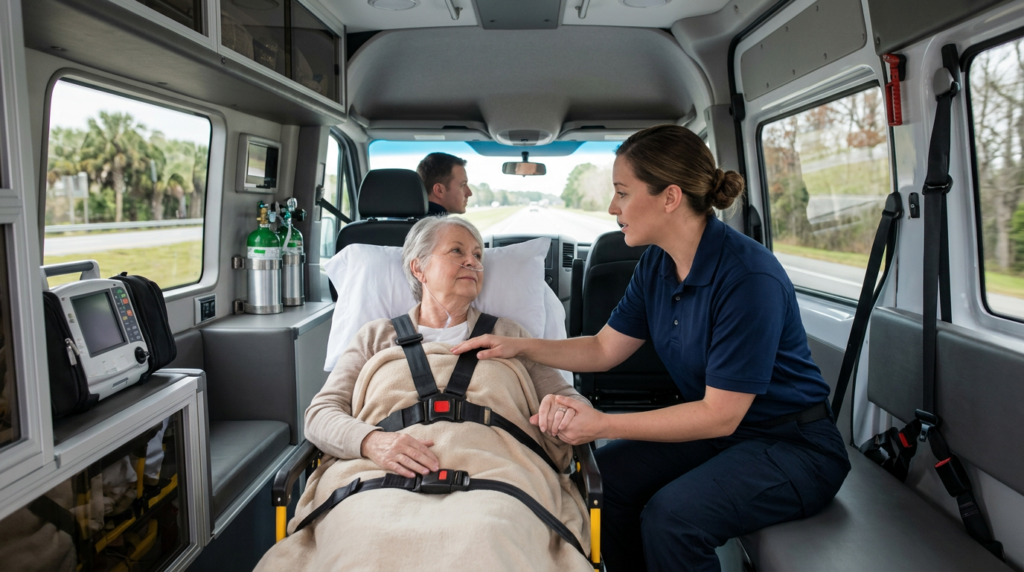
Quick answer: Confirm the patient’s mobility and medical needs (can they sit safely, wheelchair transfers, stretcher requirement, oxygen, dementia supervision, medication timing), then choose a transport type that fits: medical car, wheelchair van, or stretcher transport. Ask a short set of safety-first questions about staffing, monitoring level, equipment, and door-to-door scope, which can vary by provider and state rules. Coordinate pickup with the discharging facility and confirm the receiving facility’s acceptance window.
Start With the Right Level of Transport
The first decision is matching the ride to the medical reality, not the distance. A stable passenger who can sit upright and transfer with minimal help may do well in a medical car with assistance. Someone who can’t transfer safely, has high fall risk, or needs frequent repositioning typically needs a wheelchair van or stretcher transport. Oxygen needs also change the plan—some providers require patient-supplied oxygen, others can supply it, and backup practices can vary.
For memory loss or dementia, plan for more than “a ride.” Confusion, agitation, wandering impulses, and toileting needs can turn a long interstate trip into a safety problem. Ask if a family member can ride along, how staff handle redirection, and whether restraints are ever used (and under what medical authorization). If you’re researching Florida to NC medical transport, focus your calls on supervision, transfer safety, and medication timing as much as the vehicle type.
Get clarity on “door-to-door.” Some services will do bedside pickup from a facility and deliver inside the receiving location; others stop at the curb or require the facility to bring the patient to a lobby. That scope can vary by provider, staffing level, and facility rules, so confirm it in plain language before you book.
Fast Decision Tree and the Top 8 Questions to Ask
Simple decision tree: Choose a medical car if the patient can sit upright for the duration, can get in/out with minimal hands-on help, and does not need a wheelchair or stretcher for safe transfers. Choose a wheelchair van if the patient must remain in a wheelchair for safe movement, needs a ramp/lift, or can’t manage steps and long walks but can sit upright. Choose a stretcher transport if the patient can’t sit safely, needs to lie flat or semi-reclined, has severe weakness/pain, high aspiration risk, requires frequent repositioning, or can’t transfer without significant assistance.
Prioritized checklist (ask these 8):
1) What level of transport is being quoted (medical car, wheelchair, stretcher) and why?
2) Who will be in the vehicle (driver only, driver + attendant, nurse/EMT-level), and can a family member ride along?
3) What “monitoring” is included—does it range from observation to documented vitals, and how often, depending on provider level and state rules?
4) What equipment is included (lift, wheelchair/stretcher, transfer aids, positioning supports), and what must the patient/facility supply?
5) How are medications handled during the trip—who can remind, who can administer, and what documentation is required?
6) How do you handle toileting, incontinence care, meals, and scheduled breaks on a long drive?
7) What is the exact pickup/drop-off scope (bedside-to-bedside vs curb-to-curb), and what are the facility handoff steps?
8) What happens if the patient’s condition changes en route or the facility delays discharge—do you have escalation steps and rescheduling policies?
These questions keep the focus on safety and expectations, since staffing, monitoring, and allowable services can differ between providers and across state and facility policies.
Paperwork and Practical Prep (Commonly Requested)
Most providers and facilities commonly request a basic packet: patient demographics, emergency contacts, a current medication list, allergies, diagnosis/discharge summary, mobility status, and any special instructions for behavior or fall risk. Some will also ask for insurance information even if you’re paying privately, simply for their records. Requirements vary, so treat this as a starting point and confirm the exact list with both the transport company and the discharging facility.
Physician orders may be requested more often for stretcher transport, oxygen, or higher-acuity monitoring, but they aren’t universal and can depend on the transport type, state rules, and facility policy. The same goes for DNR paperwork: if it exists, many teams will want a copy available, and how it’s handled during transport depends on the service level and local protocols. Ask the discharging nurse or case manager what they can provide and what must travel with the patient.
Pack a small “ride kit” that stays with the patient: medications for the full day plus a buffer, water and easy snacks if allowed, incontinence supplies, wipes, a change of clothes, hearing aids/glasses with cases, and a comfort item. If dementia is involved, include a one-page sheet with triggers, calming strategies, baseline behavior, and safe ways to assist with transfers.
A Simple Timeline to Coordinate Discharge and Arrival
24–72 hours before discharge: Call the discharging unit or case manager first to confirm the expected discharge day/time window, mobility status, and any restrictions (oxygen, isolation precautions, stairs, weight/transfer needs). Then contact transport providers with that information so they can quote the correct level of service and staffing.
12–24 hours before pickup: Confirm the pickup window with the facility (not just a single time), the exact pickup location (room, unit, or lobby), and who will sign the release. Call the receiving facility in North Carolina to confirm they will accept arrival at the estimated time and to get the correct entrance and admitting process. If it’s a private home, confirm who will be present to receive the patient and whether there are steps, narrow hallways, or other access issues.
Day of transport: Have the paperwork packet and ride kit ready, keep the phone numbers for the unit nurse and the receiving contact handy, and ask the transport team what updates you’ll receive during the trip. Build in flexibility—facility discharge timing and traffic can shift the schedule, and the provider’s ability to wait or adjust may depend on staffing and policies.
If you want help lining up the right transport level and coordinating the handoffs for a long-distance trip, you can contact Managed Medical Transport, Inc.