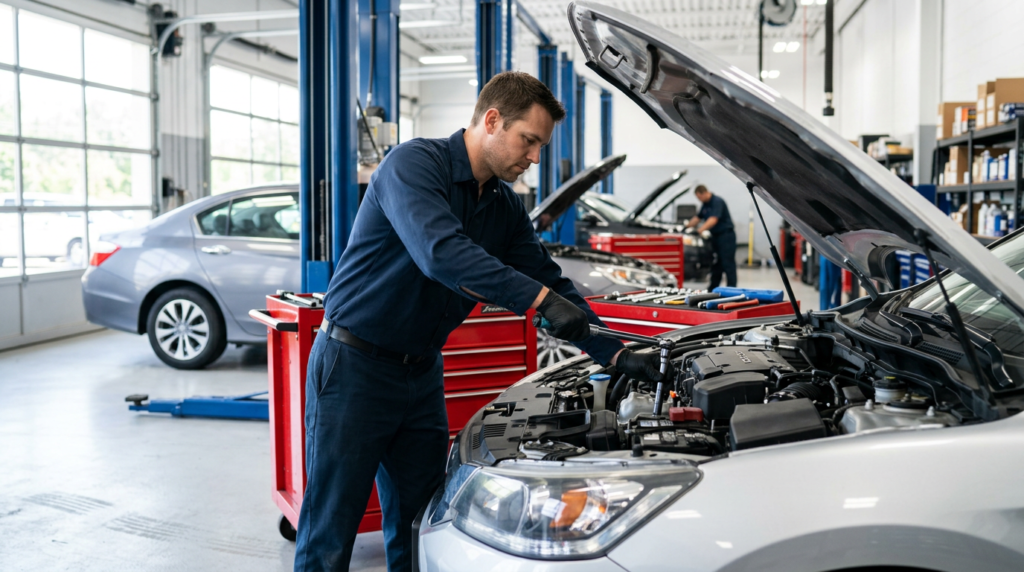
Quick answer: Choose a trustworthy mechanic by pre-screening for consistent shop details and strong local feedback, then confirming they’ll provide a written estimate and get your authorization before repairs. On the first call, ask what tests they’ll run and how they handle parts options and warranties in writing. After the repair, request documentation of findings and the final invoice breakdown so you can track the fix and plan maintenance.
Step 1: Pre-Screen Shops in Cumming Before You Call
Start by checking that the shop’s name, address, and phone number match across Google, maps apps, and any local directories. In a busy area like Cumming, inconsistent listings can mean you’re looking at an old location, a similarly named business, or a listing that isn’t actively managed.
Scan recent reviews for patterns, not perfection: clear communication, accurate timelines, and follow-through on comebacks matter more than a single glowing comment. If you’re searching for an auto mechanic Cumming GA, you can also do a quick trust checklist specific to how repairs are typically handled in Georgia: ask if you’ll receive a written estimate, confirm they’ll get your authorization before exceeding it, and verify you can receive parts/labor warranty terms in writing.
One more quick filter: look for a shop that routinely works on your make and the type of issue you have (diagnostics, brakes, AC, electrical). Specialization isn’t required, but repeat exposure to the same systems usually means faster, more accurate testing.
Step 2: First Call Questions That Prevent Guesswork
Use the first call to find out whether the shop diagnoses systematically or replaces parts to “see if it works.” Ask: “What tests will you run to confirm the cause?” and “Will you call me with results and an estimate before any repairs start?” Those questions set expectations and discourage surprise work.
Then ask about parts choices and warranty terms. A clear answer sounds like: they can offer OEM, OEM-equivalent, or aftermarket options, explain trade-offs (noise, fitment, lifespan), and put warranty coverage for parts and labor in writing on the estimate or invoice. This matters for items like sensors, ignition components, and brake parts, where low-quality replacements can repeat the same symptom and double the labor.
Finish with logistics: typical diagnostic time windows (often same-day to a day or two, depending on workload and symptom), whether they road-test, and how they’ll update you (text/call). You’re looking for a shop that can explain the process in plain language.
Step 3: Drop-Off Expectations and What to Authorize
At drop-off, provide a tight symptom description: when it happens (cold start, highway speed, turning, braking), any warning lights, smells, or recent repairs. If the issue is intermittent, a short video of the noise or dash message can help reproduce it without extra shop time.
Before you authorize work, request three things in writing: the diagnostic charge (if any) and what it covers, the estimated total for the recommended repair (parts and labor separated if possible), and what triggers a call for approval (for example, any increase beyond the estimate). If the shop recommends multiple repairs, ask them to rank them as safety/urgent vs. reliability vs. maintenance so you can make a budget-based plan without ignoring critical items.
Decision box: what to do next
Stop driving and tow if you have brake pedal sinking/metal grinding, steering that binds or suddenly pulls, an overheating gauge/steam/coolant smell, or a flashing check-engine light with shaking (possible severe misfire). Seek a second opinion if the recommendation is expensive but the explanation is vague, the shop can’t describe a confirming test, or the fix is “try these parts first.” Before authorizing repairs, ask for the written estimate, the diagnostic findings summary, and the warranty terms for parts and labor.
Step 4: After the Repair, Request Proof and a Paper Trail
When you pick up the car, ask for documentation that matches the recommendation. That can be a final invoice showing parts and labor, the diagnostic notes (codes plus what testing confirmed), and any measurements taken (brake pad thickness, tire tread depth, battery/charging readings). If you asked to see replaced parts, most shops can show them at pickup if you request it ahead of time.
Also ask what to watch for and what follow-up looks like. A good explanation includes: what symptom should be gone, what might take a short relearn period (some idle/throttle adaptations), and when to come back if something returns. Keep the invoice and any warranty statement together; it makes future troubleshooting faster and helps you avoid paying twice for the same concern.
If you’d like help applying this checklist, ask Team Ryan Automotive for a written estimate and a clear diagnostic plan before authorizing repairs.