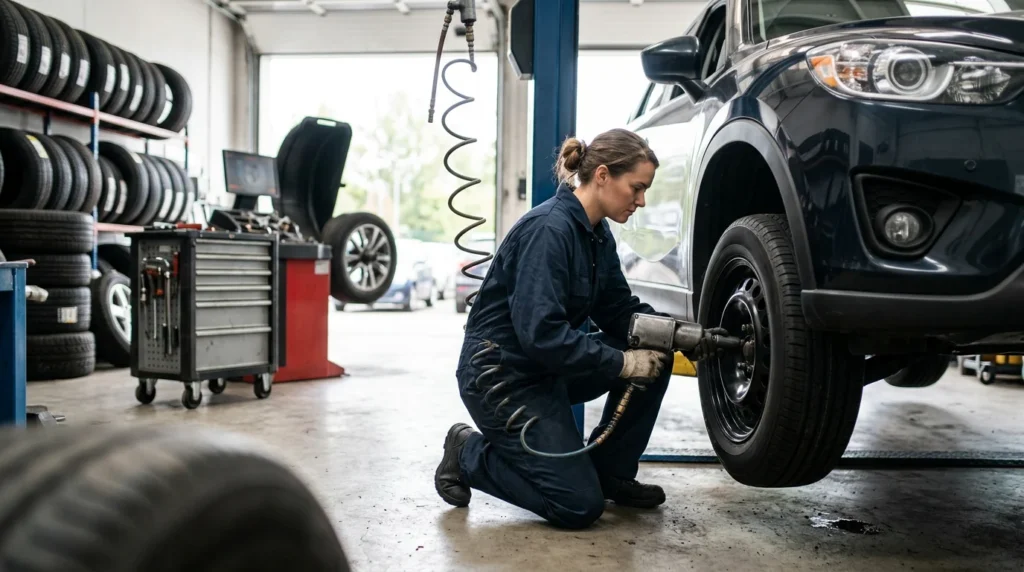
Quick answer: Most tire services cover the basics that keep your tires safe and wearing evenly: tire inspection, air-pressure check and adjustment, tread-depth measurement, rotation, balancing, flat repair (when the puncture is repairable), and mounting new tires. Many shops also check wheel condition, valve stems, and TPMS sensors, then recommend alignment if wear patterns or a pull in the steering suggest the wheels aren’t tracking straight.
What’s Typically Included
A standard visit for tire services usually starts with a quick safety check: tread depth, visible damage (cracks, bulges, exposed cords), and air pressure. If the tires are in decent shape, the most common maintenance is rotation to even out wear—especially on front-wheel-drive vehicles where the front tires often wear faster.
Balancing is often paired with rotation or new tire installation. If you feel a vibration that becomes noticeable at highway speeds, balancing is a prime suspect, though the exact speed can vary with tire size, wheel condition, and vehicle setup. Shops may also inspect valve stems for leaks, check the wheel for bends, and verify the tire bead is sealing properly.
If you’re buying tires, mounting and balancing are part of the package. Many shops will also reset or relearn the TPMS (tire pressure monitoring system) if needed, since some vehicles require a specific procedure after rotating tires or replacing sensors.
What’s Not Included Unless You Ask
Some items people assume are automatic are often separate services. Alignment is commonly recommended based on symptoms or wear patterns, but it may not be included with a rotation or new tires unless it’s specifically added.
Other add-ons to confirm when booking include a deeper suspension/steering inspection (for worn tie rods, ball joints, or shocks/struts), TPMS sensor replacement (not just relearn/reset), road-force balancing (more advanced than standard balancing), and any road-hazard coverage or warranty terms for new tires.
Flat Repair vs. Replacement
Not every puncture can be safely repaired. A repair is usually possible when the hole is in the main tread area and the tire hasn’t been driven on while flat. If the damage is on or near the sidewall/shoulder, or if there’s a bulge from internal damage, replacement is the safer call.
A proper repair typically involves removing the tire from the wheel and sealing the injury from the inside (often with a patch-plug style repair). A quick exterior plug can be a temporary fix on some tires, but it doesn’t address internal damage the way an internal repair does.
If only one tire is damaged, ask about tread-depth matching. On some all-wheel-drive vehicles, a large tread difference between tires can stress the drivetrain, so you may need a closely matched tire or a pair instead of a single.
Use this simple flow to decide what to request:
- Replace now (don’t drive far): cords showing, a sidewall bulge, a cut in the sidewall, or a tire that was driven flat.
- Repair: a nail/screw in the tread area with slow leakage and no obvious internal damage.
- Rotate and balance: uneven wear front-to-rear, or a vibration/shimmy that changes with speed.
- Alignment check: steering pull, off-center wheel, rapid edge wear, or uneven wear that returns soon after rotation.
- Diagnose leaks: repeated air loss after filling, which can point to a bead leak, valve stem issue, wheel corrosion, or a puncture.
Signs You Need Alignment or Balancing
Tires can tell you what’s wrong if you know what to look for. A steering wheel that’s off-center, the car drifting on a flat road, or rapid wear on one edge of the tread can point to alignment issues. Cupping or scalloped wear can be related to worn suspension parts, imbalance, or a combination.
Balancing problems usually feel like a shake that changes with speed. Alignment problems more often show up as a pull or uneven wear over time. If you install new tires, an alignment check is a smart add-on when the old tires wore unevenly, or if you’ve hit a pothole hard enough to bend a wheel or knock the steering out of spec.
Ask the shop to measure tread depth on all four tires and show you the readings; request a printout if alignment is checked.