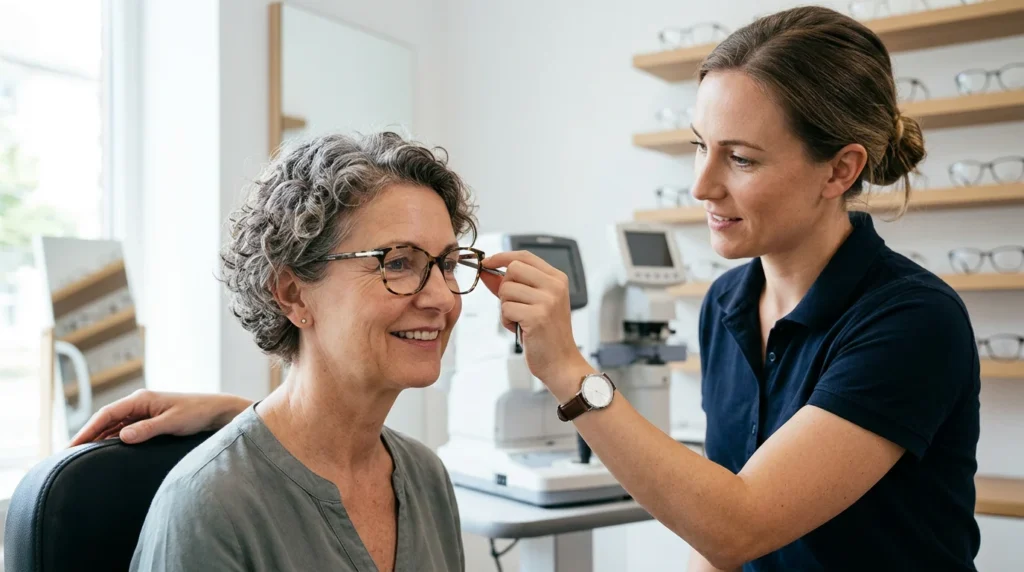
Quick answer: Progressive lenses are often worth it if you need both distance and near correction and want one pair of glasses for most tasks. They blend far, intermediate, and reading powers without a visible bifocal line. Many people adapt in a few days; for some it can take 1–2+ weeks. If dizziness, headaches, or persistent blur continues after steady wear, a re-check of fit and prescription is warranted.
What Progressive Lenses Actually Do
Quick decision check:
- Worth it if you switch between phone, computer, and distance tasks all day and hate swapping glasses.
- Worth it if you drive regularly and want one pair for dashboard + road.
- Worth it if you need stronger near help and want no bifocal line.
- Not worth it if you do 6–8 hours of close work at a fixed distance and need a wide, stable near/intermediate view (an office lens may feel better).
- Not worth it if you’ve had strong motion sensitivity or “swim” with past lens changes and can’t tolerate an adaptation period.
Progressive lenses combine multiple prescriptions—distance, intermediate, and near—into one lens with a gradual change in power. That intermediate zone is what makes computer screens, dashboards, and countertop tasks easier compared with standard bifocals that jump straight from far to near.
If you’ve started holding your phone farther away, getting headaches after close work, or constantly swapping between readers and your regular glasses, Progressive lenses and eyewear can be a practical everyday solution. Think of someone doing 8 hours at dual monitors, then driving home and reading a menu on the way—one pair can cover all of that.
Many people adapt in a few days; for some it can take 1–2+ weeks of consistent wear. If symptoms like dizziness, nausea, headaches, or persistent blur don’t improve with steady use, get the prescription and fitting re-checked rather than forcing it.
Who Usually Likes Them—and Who Might Not
Progressives often work well for people who bounce between distances: retail work (reading shelf labels, then looking across an aisle), cooking, errands, and driving. They’re also a good fit if you want a single everyday pair without visible lines.
They can be frustrating for tasks that demand a wide, stable field at one distance. For example, if your day is mostly spreadsheet work at a fixed monitor distance, a dedicated “office” or computer lens typically gives a larger intermediate/near area than a standard progressive. If you do detail hobbies that require scanning side-to-side up close, you may notice the near zone feels narrower than readers.
If you’ve disliked progressives before, try to describe what failed: blur (can’t get it clear even when centered) versus swim (the world feels like it shifts or tilts when you move your head). That distinction helps pinpoint whether the issue is prescription, lens design, or fit/alignment.
Frame Fit and Measurements Matter More Than Most People Think
Progressive lenses are sensitive to how they sit on your face. A frame that’s too shallow can squeeze the usable reading area; many opticians look for enough vertical lens depth to fit the distance-to-near progression comfortably (often around the low-30 mm range or more, depending on the lens design). If the frame rides low or the nose pads slip, you may feel like you’re constantly hunting for focus.
Accurate measurements—pupillary distance and fitting/segment height—place the viewing zones where your eyes naturally look. Small errors can cause blur, unwanted head tilt, or neck strain from lifting your chin to find the right corridor. Practical tip: bring your typical work posture into the conversation (laptop low on a desk vs monitor at eye level), because that changes where you need the intermediate zone.
Many people adapt in a few days; for some it can take 1–2+ weeks. If you still feel off after a solid adjustment window, persistent symptoms are a reason to re-check the fit, frame position, and lens choice.
How to Choose the Right Pair for Your Day-to-Day
Match the lens to your most frequent distance. If you spend most of the day at a computer, ask about an office/computer lens rather than a general progressive; it usually gives a wider intermediate zone and reduces the “chin up” posture. If you’re mostly on your feet with frequent distance changes—like walking a store floor, checking labels, then looking across the room—a general progressive is often more convenient.
Give concrete examples of where it fails: “I can see the road, but the dashboard is fuzzy,” or “text is clear only if I tilt my head back,” or “I feel swim when I turn quickly in aisles.” Also consider glare control if you drive at night; an anti-reflective coating can reduce distracting reflections on headlights and screens.
If you want help choosing a lens design, confirming measurements, and troubleshooting comfort issues, Georgia Eye can help you narrow down an option that fits your routine.