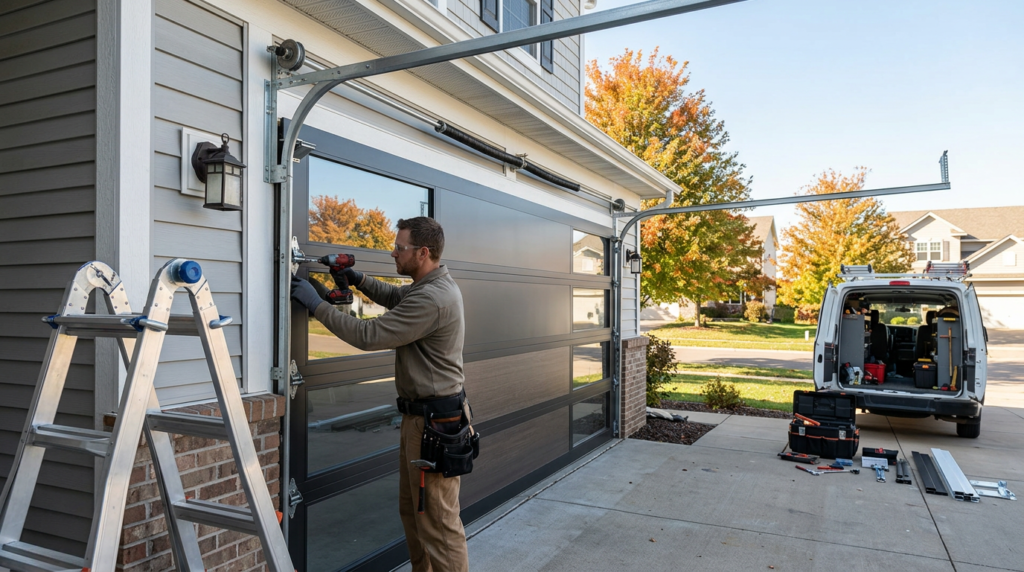
Quick answer: You usually need repair when the door is structurally sound but has a worn spring, frayed cable, misaligned sensors, noisy rollers, or an opener issue. Replacement makes more sense if the door is bent, cracked, rotted, badly rusted, repeatedly failing, or no longer safe due to damaged panels or a compromised track system. A quick on-site inspection can confirm what’s cost-effective and safe.
Quick Signs You Can Repair
Many garage door problems involve a few common wear items rather than the door itself failing. If the door still moves smoothly by hand (with the opener disconnected) and the panels aren’t damaged, repair is often the practical choice. During a garage door service Blaine MN visit, the goal is to identify which component is causing the symptom and whether the door is still structurally sound.
Typical repair candidates include broken torsion or extension springs (the door suddenly feels extremely heavy), worn rollers (rattling or grinding), loose hinges, or a door that’s come slightly out of alignment. Opener problems also tend to be repairable: stripped gears, a failing capacitor, a misadjusted travel limit, or photo-eye sensors that blink and stop the door from closing.
One simple homeowner check: with the door closed, pull the emergency release and lift the door manually. It should lift without excessive force and stay about halfway up. If it slams down or shoots up, the spring system is likely out of balance and needs professional service.
Red Flags That Point to Replacement
Replacement is more likely if the door itself is compromised. Look for panels that are creased from impact, wood sections that are soft or rotting, widespread rust at the bottom edge, or a door that has started to “wave” as it moves. A door can sometimes be patched with a single panel swap, but matching older styles and colors can be difficult, and repeated panel issues often signal the door is nearing the end of its useful life.
Track damage is another big one. If the vertical or horizontal tracks are bent, pulling away from the framing, or badly corroded, you may be facing more than a tune-up. Minor track alignment is common; major deformation can create binding, cable issues, and safety risks.
Frequent breakdowns also matter. If you’ve had multiple spring, cable, and roller failures close together, the door may be stressing components due to age, weight, or poor fit. In that situation, replacement can reduce recurring service calls and improve reliability.
Blaine-Specific Factors and a Simple Cost Rule
In Blaine, a few local realities can push the decision one way or the other. Winter road salt and slush tracked into the garage can speed up bottom-panel rust and hardware corrosion, especially on unsealed concrete where salty water sits. Freeze–thaw cycles can also swell and split wood trim and older wood doors, making rot and sticking more likely around the bottom edge.
Cold winters make insulation and air sealing more than a comfort upgrade. If your garage is attached (or there’s living space above), upgrading to an insulated door and fresh perimeter seals can reduce drafts and help the opener and springs by smoothing operation in colder temps. Windy days and wide double doors can also expose weak, flexing panels; if the door “bows” noticeably, reinforcement or replacement may be safer than repeated adjustments.
Decision rule (typical range): if a proposed repair is roughly 30–50% or more of the cost of a comparable replacement door, many homeowners start leaning toward replacement. Common exceptions: custom or hard-to-match doors where replacement costs are higher, newer insulated doors where repairing one system (like springs) is still a good value, and cases where only a single panel is damaged and a true match is available.
Call a Pro Now: Urgent Symptoms
Stop using the door and get professional help promptly if you notice: a hanging or frayed cable, the door off its track, a visible gap in a torsion spring, the door won’t stay open when lifted by hand, the track is pulling away from the framing, or the opener strains and the door barely moves.
What to do immediately: keep people and pets away, don’t try to “help” the door by lifting it with the opener, and avoid DIY spring or cable work. If the door is stuck open and it’s safe to do so, disconnect the opener using the emergency release and leave the door alone until it can be secured by a technician.
If you want a straightforward recommendation on repair versus replacement, AA Garage Door is a practical place to get help.