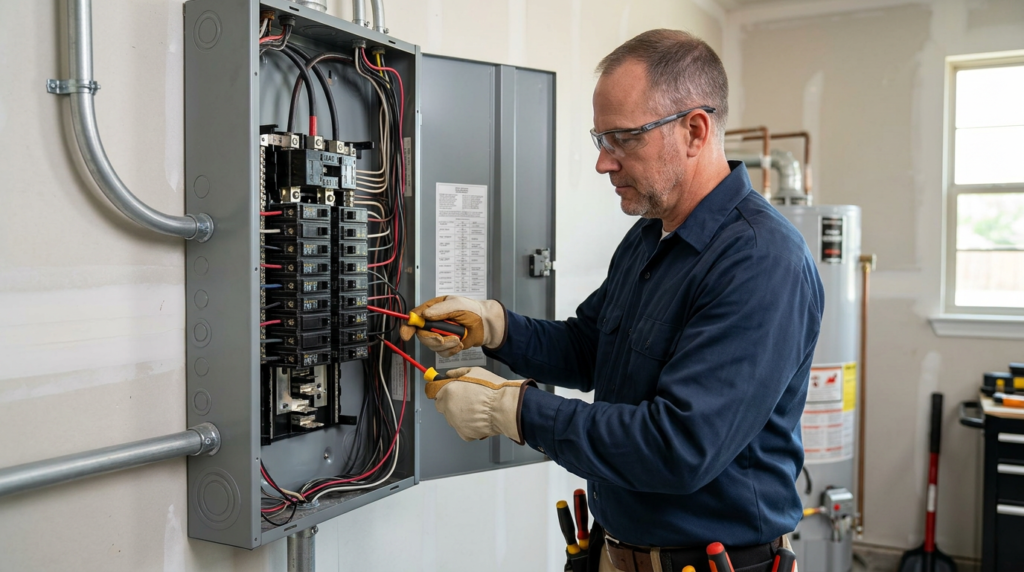
Quick answer: Electrical services in Spring Branch, TX typically cover troubleshooting and repairs (outlets, breakers, lighting), panel and breaker upgrades, new circuits for appliances, ceiling fan and fixture installs, surge protection, and safety checks. Many electricians also handle code-correcting fixes after inspections, generator transfer switches, and exterior/landscape lighting. The right service depends on the symptom—flickering, tripping, heat, or burning smells all point to different risks.
Common Jobs Homeowners Call For
Most calls start with a problem you can feel: lights flickering, a breaker that won’t stay reset, outlets that stop working, or a switch that feels warm. A typical electrician will trace the circuit, test for voltage drop, inspect connections, and identify the failure point—examples include a loose neutral, a failing receptacle, a damaged cable, or a breaker that no longer holds its rating.
Beyond repairs, common work includes installing new light fixtures and ceiling fans, adding dedicated circuits for microwaves, refrigerators, garage freezers, EV chargers, or workshop tools, and replacing outdated or damaged receptacles (including GFCI/AFCI protection where required). If you’re comparing electrical services spring branch tx, ask if the contractor will also check the whole circuit for overheating and improper splices, not just swap the obvious failed part.
Exterior needs come up a lot too: weatherproof outlets, motion lights, security lighting, and troubleshooting landscape lighting that keeps tripping. Examples include moisture getting into a box or connector, nicked low-voltage cable, or a failing transformer. Spring Branch conditions can be tough on outdoor gear in general—heat, sudden downpours, and humidity can all accelerate corrosion and water intrusion—so exterior troubleshooting may include opening and re-sealing boxes and replacing weathered covers.
Signs You Need Repair Versus An Upgrade
Repairs make sense when the issue is isolated: one dead outlet, one flickering fixture, or a single breaker that trips under a known load. Upgrades become the safer choice when the system is showing broad stress—frequent nuisance trips across multiple circuits, dimming lights when large appliances start, or multiple warm outlets/switches.
Burning smell, visible scorching, buzzing/arcing sounds, or a device/cord that’s hot to the touch are high-risk symptoms. Stop using that circuit or device, switch the breaker off if you can do so safely, and keep people away from the area until it’s checked. Do not keep resetting a breaker that trips repeatedly.
Panel and service upgrades are commonly recommended when you’re adding major new loads (like an EV charger, hot tub, or large HVAC equipment) or when the existing panel is full and you’re out of breaker spaces. Another trigger is evidence of heat damage: discoloration around breakers, a melted bus bar, or a persistent burning smell.
Homes in and around Spring Branch can include a mix of older builds and renovations. As a general regional pattern (not a guarantee for any specific house), electricians sometimes find older branch-circuit layouts, DIY additions from past remodels, or older two-prong receptacles that need grounding corrections. Inspection-driven fixes are also common during a sale or insurance review, where issues like missing GFCI protection, open grounds, or unbonded metal boxes get flagged.
What’s Usually Included In A Standard Service Call Vs. Quoted Add-Ons
A standard service call commonly covers arrival, basic diagnosis/testing, and a straightforward repair if it’s small and immediately accessible. Diagnosis may include checking the panel, verifying breaker operation, testing at the device, and confirming grounding/polarity. Some electricians also provide brief written notes on what they found and what they changed.
What varies by contractor is what’s bundled versus quoted separately. Examples of add-ons include: larger parts/materials (breakers, fixtures, GFCIs, wiring), extended troubleshooting time, opening walls/ceilings, replacing multiple devices, load calculations for new equipment, and returning for a second visit. Documentation can vary too—some provide a simple invoice description, while others can provide more detailed write-ups or photos if requested.
Permits and inspection coordination also vary. For work like service/panel changes, new circuits, or generator transfer equipment, permits and inspections are commonly required, and some contractors will handle coordination while others expect the homeowner to be involved. Ask up front what they will file, what you need to sign, and whether the quoted scope includes the inspection visit.
What To Do Next Before You Call
Having a few details ready can make troubleshooting faster. Before you call, note: which breaker number/label is involved (and whether it’s a standard, GFCI, or AFCI breaker), what was running when the issue happened, whether it happens only at certain times (rainy weather, afternoon heat, when the AC starts), and which rooms/outlets/lights are affected. If it’s safe, take clear photos of the panel directory, the breaker that trips, and any visible discoloration on outlets/switches.
Ask the electrician specific questions so you know what you’re paying for: What testing steps will you use (voltage drop, load checks, insulation/continuity as needed)? Will you verify torque/terminations at the panel and at the device? If you’re adding load (EV charger, appliance, workshop), will you do a basic load calculation and confirm conductor/breaker sizing? Will this job require a permit or inspection, and who handles it?
If you want help scheduling the right kind of troubleshooting or upgrade, Bolt Electric is a practical place to start.