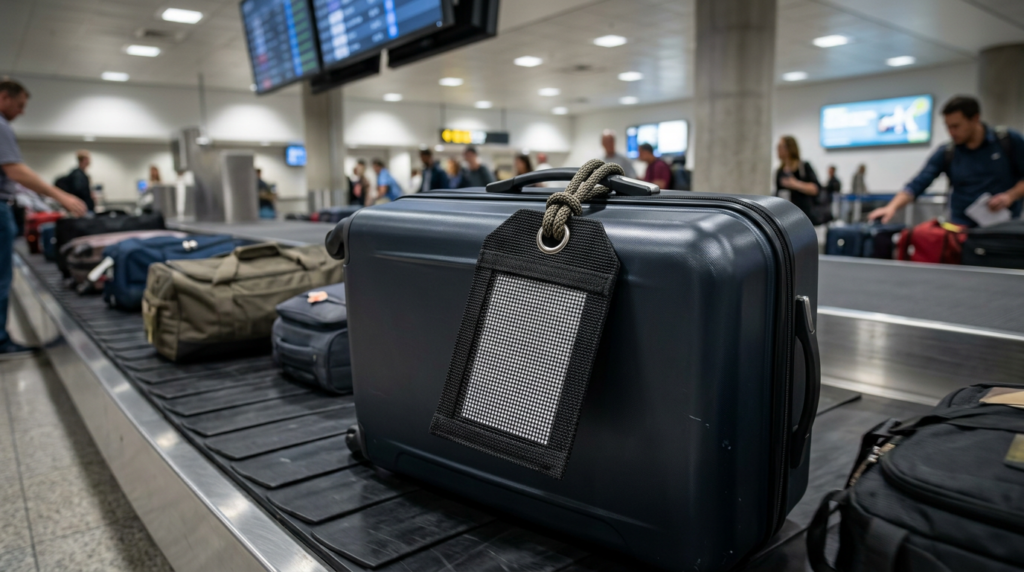
Quick answer: A heavy luggage tag in 18 mesh needlepoint is a stitchable tag blank made from fine 18-count canvas with a sturdier finishing style meant to handle travel wear. It’s a good fit for stitchers who want crisp detail (small letters, logos, borders) and a tag that typically stays firm instead of floppy. After stitching, it’s commonly finished with reinforcement, protected edges, and a secure loop for travel handling.
What “18 Mesh” And “Heavy” Mean In Practice
“18 mesh” means 18 holes per inch on the canvas, which gives a tighter, more detailed look than larger meshes. That’s helpful for clean monograms, small icons, and neat borders that can look blocky on 13 mesh. The trade-off is that stitching usually takes longer and you’ll want a thread that covers well without feeling bulky.
“Heavy” is usually shorthand for construction and finishing choices that help a tag hold its shape and resist abrasion. Travel tags get flexed and rubbed against zippers and conveyor belts, so makers often build in extra structure. Common industry options include: a vinyl, leatherette, or coated canvas backing; bound edges (tape binding) or stitched-and-turned edges with piping; internal stiffener layers (thin plastic sheet or heavy interfacing); and a buckle strap or riveted loop instead of a simple tie. If you’re shopping for a blank like the heavy luggage tag 18 mesh, plan your design around readability at arm’s length and choose colors that don’t disappear against a busy suitcase.
If you’ve only stitched ornaments or flat canvases, a luggage tag can be a fun step up because it combines a small design area with real-world durability demands.
Who It’s For (And Not For)
A “heavy” 18 mesh tag is often best for frequent travelers, gift-givers who want a polished keepsake, and detail-focused stitchers who enjoy crisp lettering. It may be less satisfying if you want a super-quick project, prefer chunky stitches, or need a tag that can be tossed in a beach bag without thinking about scuffs.
Quick decision guide:
18 mesh vs 13 mesh (typical trade-offs)
18 mesh: finer detail, smaller letters look cleaner, stitching usually takes longer, coverage can be fussier with some threads.
13 mesh: bolder/graphic look, faster stitching, easier coverage, fine text can look blocky.
What To Stitch (And What To Avoid) On A Travel Tag
Keep the front bold and simple. A monogram, first name, short phrase, or a high-contrast motif is usually easiest to spot at baggage claim. Dark outlines around light letters (or vice versa) often help the design read quickly. On 18 mesh, you can fit cleaner curves and smaller type, but tiny text still tends to get lost when the tag is swinging from a handle.
Avoid stitching sensitive personal info on the outside. Many people skip phone numbers and addresses on the stitched face and instead use an insert card on the back or inside the tag if the style allows it. If you want an identifier, initials plus a distinctive color scheme is often enough to tell your bag from a sea of similar luggage.
For thread choice, pick something that wears well and won’t fuzz quickly. Smoother fibers commonly stay sharper on a high-touch item like a luggage tag, while fuzzy or loosely spun threads can pill with friction.
Finishing Details That Make It Last
Durability is mostly about finishing. A well-finished tag typically has protected edges, a scuff-resistant backing, and a closure that doesn’t gape. The attachment point is a common failure point; narrow straps can tear or loosen if the hardware is light-duty or the connection isn’t reinforced.
Use this quick checklist when buying or finishing a tag: (1) Edge: bound, piped, or otherwise protected with no raw canvas showing; (2) Backing: vinyl/leatherette/coated material or another wipeable surface; (3) Strap: buckle strap or reinforced loop with secure hardware; (4) Closure: snaps/Velcro/cover flap that stays shut; (5) Rigidity test: hold it by the strap—does the body stay fairly flat, and does the edge feel firm instead of collapsing?
If you travel often, it also helps to make the tag easy to remove so you can swap it between bags without stressing the hardware. For canvas selection, thread pairing, and finishing options, Blue Willow Needlepoint can help you choose a tag setup that matches how you actually travel.